
Money, Mindset, and Movement: What Growth Looks Like in Caribbean Culture
MAY - MONEY, MOVES & CELEBRATIONCULTUREMINDSET
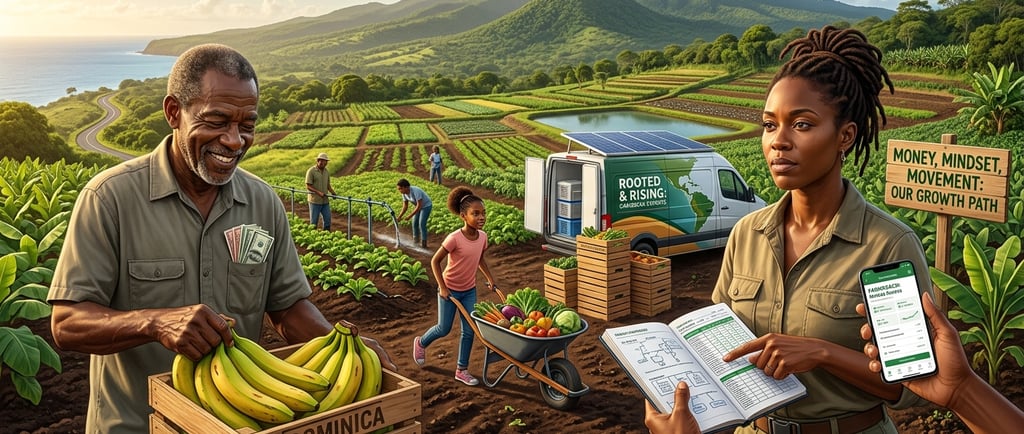
Money conversations in Caribbean households growing up were… complicated. On one hand, you watched your parents work incredibly hard. On the other hand, nobody really sat you down and explained how money worked — how to save it, grow it, or make it work for you. What you learned, you picked up from watching, listening, and figuring it out on your own.
That's changing. A new generation of Caribbean people — in the islands, in Atlanta, in Toronto, in London, in New York — is having different conversations about money. Not just how to make it, but how to think about it. And that shift in mindset is producing a different kind of growth.
"How you think about money determines what money does for you."
The Old Relationship With Money
In many Caribbean households, money was discussed in terms of survival. Enough to pay the bills. Enough to send home. Enough to give the children a better life than you had. Those are noble goals, and they produced a generation of the hardest workers in the world.
But there were also some quiet beliefs that got passed down alongside the work ethic — beliefs like 'rich people are different from us,' or 'you have to struggle before you can be comfortable,' or 'don't talk about money, that's bad manners.' These beliefs were never meant to hold anyone back. But they did.
The Mindset Shift That Changes Everything
The shift begins when Caribbean people start questioning those inherited beliefs. When a young Jamaican woman starts investing instead of just saving. When a Trini man starts building passive income alongside his job. When a Barbadian family starts talking about generational wealth at the dinner table instead of just hard work.
The belief that money is for 'other people' — people born into it, people who got lucky — starts to crack when you see people who look like you building something real. That visibility matters. It's why representation in business and finance isn't just a feel-good idea. It literally changes what people believe is possible for themselves.
Movement Is the Bridge Between Mindset and Money
Here's what no one says enough: mindset alone doesn't make you wealthy. Action does. The shift in thinking has to be followed by movement. Real, consistent, sometimes uncomfortable movement.
That might look like starting a business even before you feel ready. Investing a small amount every month even when the amount feels embarrassing. Charging what your work is actually worth even when someone says it's too much. Saying no to spending that doesn't serve your goals even when everyone around you is living large right now.
Caribbean culture understands movement. We understand showing up. The task is channeling that energy — that drive, that work ethic — into a direction that builds, not just sustains.
"Motion without direction is just noise. Direction without motion is just a dream. You need both."
What Growth Actually Looks Like
Growth in Caribbean culture isn't always loud. Sometimes it looks like quietly paying off debt nobody knows about. Like building a savings account for the first time. Like having a business that generates income while you sleep. Like being able to take care of your parents without stress.
It also looks like community. Caribbean people have always understood that individual success is sweeter when the whole community eats. That's why support networks — the cookouts, the pop-ups, the word-of-mouth — are still the most powerful marketing in this culture.
The Conversation Is Happening
Right now, across the Caribbean diaspora, money and mindset conversations are happening at a level that would have been unimaginable even ten years ago. Podcasts, social media, community spaces — the dialogue is alive. People are asking better questions. Making bolder moves. Building things that will outlast them.
That's growth. Not just financial. Personal. Cultural. Generational.
And it starts with deciding that the old story — the one that said 'not for us' — was never yours to carry in the first place.
🎙️ Catch the latest conversations on culture, business, and Caribbean life on CariVibez Radio — live every day at CariVibez.com

CariVibez Radio · Island rhythm. Real connection.
Contact
Newsletter
© 2020-2026 CariVibez. All rights reserved.


QUICK LINKS
Advertise with Us
Media Kit
Press Kit
Events Calendar