
How to Position Your Brand for Growth Without Overcomplicating It
MAY - BUSINESS & ADVERTISERSBIZ BRAND POSITIONING
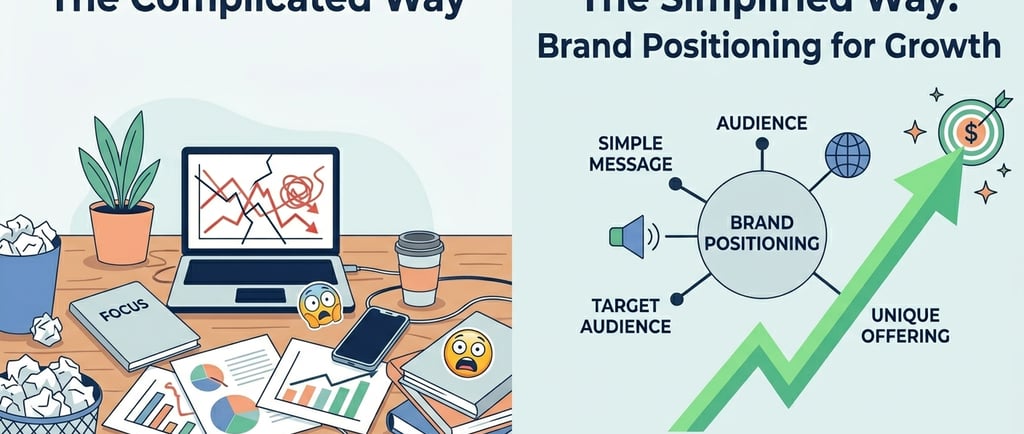
Brand positioning. It's one of those phrases that can sound overwhelming, especially if you're a small business owner who just wants to get clients and keep the lights on. But here's the truth: positioning isn't complicated. It's just the answer to one question: in your customer's mind, what do you stand for?
Not what you sell. Not your services or your products. What you stand for. What you represent. What comes to mind when someone says your name.
That question has a big impact on your growth — because how people perceive your brand determines whether they choose you, what they're willing to pay you, and whether they recommend you.
"You don't build a brand by telling people what you do. You build it by showing them what you stand for."
The Positioning Problem Most Small Businesses Have
Most small businesses are positioned by default rather than by design. They haven't made intentional choices about what they want to be known for, so the market makes those decisions for them — often in ways that limit growth.
A restaurant that hasn't positioned itself clearly might get known as 'that Caribbean place on Peachtree' — which isn't wrong, but it's not compelling. A business that has positioned well might be known as 'the place that makes you feel like you're in Kingston even when you're in Atlanta.' Same restaurant. Very different perception. Very different pricing power.
Start With Your Best Customer
Positioning starts with specificity about who you're for. The temptation is to say 'everyone' — but everyone isn't a positioning strategy. Everyone is no one.
Think about your best customers right now. Not the most profitable necessarily, but the ones who love what you do, who tell their friends, who come back without being chased. What do they have in common? What problem did you solve for them? What made them choose you over someone else?
The answers to those questions are the raw material of your positioning. You're not making something up — you're identifying what's already true and making it clearer.
Three Things Your Positioning Must Communicate
Who it's for. Not everyone. A specific person with a specific situation or desire.
What makes it different. Not just 'quality service' or 'great food.' Everyone says that. What is the specific thing that your best customers would miss if you disappeared?
Why it matters. The emotional reason someone chooses you over the alternative. This is almost never about price. It's about how you make them feel.
Consistency Is How Positioning Becomes Real
Positioning isn't a tagline. It's every touchpoint — the way you answer the phone, the way your social media looks, the way your space feels, the words you use in your marketing, the experience your customers have from first contact to last.
Consistent experience over time is what turns positioning into reputation. And reputation, in Caribbean business culture, is everything.
Keep It Simple
You don't need a branding agency or a 40-page strategy document to get this right. Write one clear sentence: we help [specific who] do [specific what] so that [specific emotional result]. Tape it up where you see it every day. Make every decision run through that filter.
That's positioning. Simple, clear, powerful. And it's the foundation of growth that doesn't require you to compete on price.
📣 Position your brand alongside Caribbean culture. Advertise on CariVibez Radio and be part of a platform your audience already trusts. Visit CariVibez.com

CariVibez Radio · Island rhythm. Real connection.
Contact
Newsletter
© 2020-2026 CariVibez. All rights reserved.


QUICK LINKS
Advertise with Us
Media Kit
Press Kit
Events Calendar